
Analysing Aidan O'Brien's St Leger Dominance
 Available in US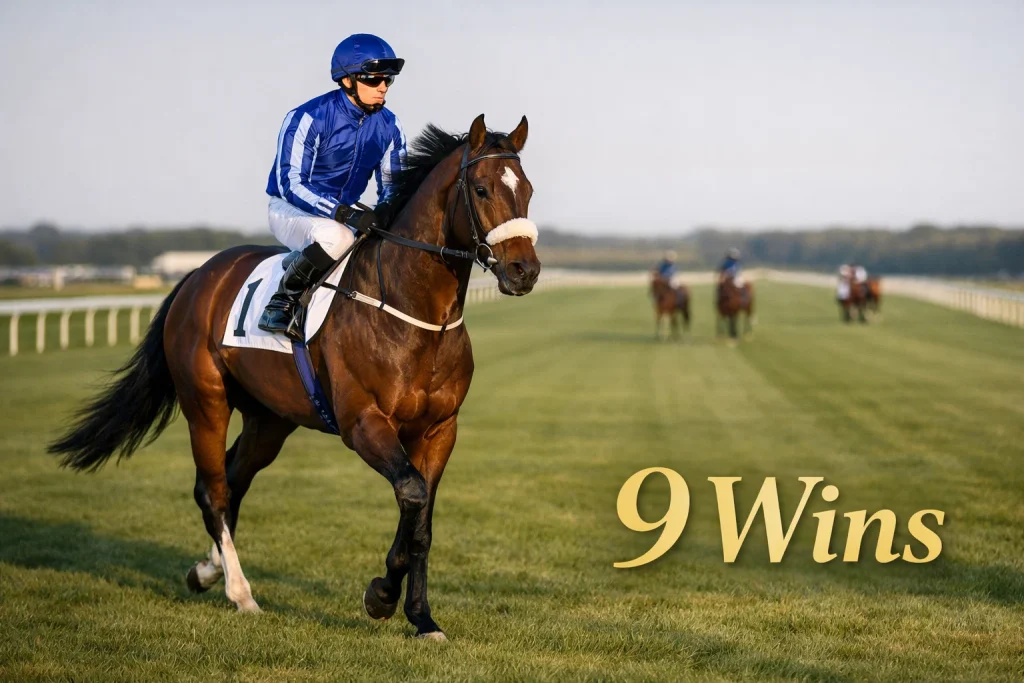
Aidan O’Brien’s St Leger record stands at nine victories — more than any other trainer alive, and second in the all-time list only to the Victorian-era John Scott, whose sixteen wins came in a fundamentally different sport. The most remarkable element of O’Brien’s record is not the number itself but the manner of its recent accumulation: three consecutive St Leger victories from 2023 to 2025, a feat no trainer had achieved in the race’s 249-year history.
For punters assessing the 2026 St Leger, O’Brien’s dominance is the single most important contextual factor. Understanding how he has built this record — which horses, which routes, which jockeys — provides a framework for evaluating whether the streak continues or whether 2026 is the year Ballydoyle’s grip finally loosens.
Aidan O’Brien St Leger Winners: The Nine Victories Analysed
O’Brien’s nine St Leger winners span nearly a quarter of a century, reflecting the sustained depth of the Ballydoyle operation rather than a single purple patch. The full list: Milan (2001), Brian Boru (2003), Scorpion (2005), Leading Light (2013), Capri (2017), Kew Gardens (2018), Continuous (2023), Jan Brueghel (2024), and Scandinavia (2025).
Each winner tells a slightly different story about O’Brien’s approach. Milan and Brian Boru were robust, middle-distance types who stayed well — horses that won through honest galloping rather than tactical brilliance. Leading Light, ridden by Joseph O’Brien (Aidan’s son), was a horse who improved dramatically through his three-year-old season, arriving at Doncaster as a progressive stayer at the peak of his form. Capri in 2017 was more surprising — a horse whose stamina was questioned before the race but who proved equal to the test under Ryan Moore.
Kew Gardens (2018) marked the beginning of the current era of dominance. Ridden by Moore, he won a tactical St Leger on good to firm ground, demonstrating that O’Brien could win the race on any surface with any type of horse. Kew Gardens went on to have a productive career at staying distances, winning the Ascot Gold Cup the following year — a progression that underlined the quality O’Brien was sending to Doncaster.
Then came a gap. The 2019, 2020, 2021, and 2022 editions were won by other trainers — Gosden with Logician, Joseph O’Brien with Galileo Chrome, Charlie Appleby with Hurricane Lane, and Roger Varian with Eldar Eldarov. Four different yards, four different approaches, and for a brief period it looked as though the St Leger had become an open race again. That illusion lasted exactly one year. In 2023, Aidan O’Brien returned with Continuous and the three-peat began.
The common thread across all nine winners is not a single horse type but a consistent training philosophy. O’Brien identifies horses in his string who possess the combination of class and stamina that the St Leger demands, routes them through appropriate trials, and delivers them to Doncaster in peak condition. The system works because it is systematic — not reliant on one exceptional horse but on a pipeline that produces St Leger candidates year after year.
Continuous, Jan Brueghel, Scandinavia: The Historic Streak
The three-peat of Continuous (2023), Jan Brueghel (2024), and Scandinavia (2025) is the centrepiece of O’Brien’s St Leger legacy. No trainer in the race’s history had won three consecutive runnings. The achievement is made more impressive by the fact that each victory came with a different horse — this was not a single champion returning to defend his crown but three separate products of the Ballydoyle system, each proving the point in its own way.
Continuous won the 2023 St Leger via the Great Voltigeur at York, completing the trial-to-Classic double that has been a hallmark of St Leger form for decades. Ryan Moore rode with typical patience, allowing the horse to travel through the race before quickening in the straight. It was a controlled, professional victory — the kind that O’Brien’s operation produces almost to template.
Jan Brueghel in 2024 was a different proposition: an unbeaten colt with tactical speed who won on good to soft ground under Sean Levey, suggesting that O’Brien’s reach extends to every going variant the race can produce. Levey, a former Ballydoyle apprentice, delivered a polished ride in a race that saw O’Brien’s trio dominate the finish.
Scandinavia in 2025, ridden by Tom Marquand, completed the streak on soft ground. O’Brien noted after the race that his horse had genuine class and handled the testing conditions with composure. The victory was significant for Marquand too — his second St Leger, following Galileo Chrome in 2020, both times for an O’Brien (Joseph in 2020, Aidan in 2025). O’Brien’s career tally of close to 400 Group 1 victories and more than 55 Irish Classics provides the context: this is not a trainer who peaks for one race. The St Leger is simply one expression of a dominance that spans the entire European flat programme.
Inside Ballydoyle: How O’Brien Prepares St Leger Candidates
Ballydoyle, O’Brien’s training base in County Tipperary, is the engine room of this success. The facility, funded by the Coolmore Stud operation, houses hundreds of horses in training at any given time and operates at a scale that no rival European flat yard can match. The gallops at Ballydoyle include an uphill stretch that replicates the demands of a staying race — a physical test that helps identify which horses in the string have the aerobic capacity for distances beyond a mile and a half.
The Irish racing industry that supports Ballydoyle is itself a formidable economic force. A Deloitte report for Horse Racing Ireland valued the industry’s contribution to the Irish economy at €2.46 billion in 2022, supporting over 30,350 jobs. That infrastructure — the breeding farms, the veterinary expertise, the training facilities, the sales operations — creates an ecosystem that produces Classic-calibre horses at a rate no other country can sustain. O’Brien operates at the apex of that ecosystem, with first pick of the best-bred yearlings at the Coolmore sales and the resources to develop them through a structured programme towards specific targets.
For the St Leger specifically, the Ballydoyle approach involves identifying horses who show both speed and stamina in their two-year-old seasons, testing them over middle distances in the spring and early summer of their three-year-old year, and then routing the best stayer through a trial — usually the Irish Derby, the Great Voltigeur, or both — before committing to Doncaster. The decision to run in the Leger rather than the Arc is often made late, depending on how the horse responds to the trials and what conditions are expected at each venue.
For punters, the takeaway is structural: O’Brien’s St Leger success is not a streak that can end by random chance. It is the product of a system designed to produce Classic winners. The streak will end when a rival trainer produces a better horse on the day — and that is always possible. But opposing O’Brien because the streak “must end sometime” is a weak betting thesis. The system endures, even when individual horses come and go.
