
A Guide to Doncaster Racecourse and Town Moor
 Available in US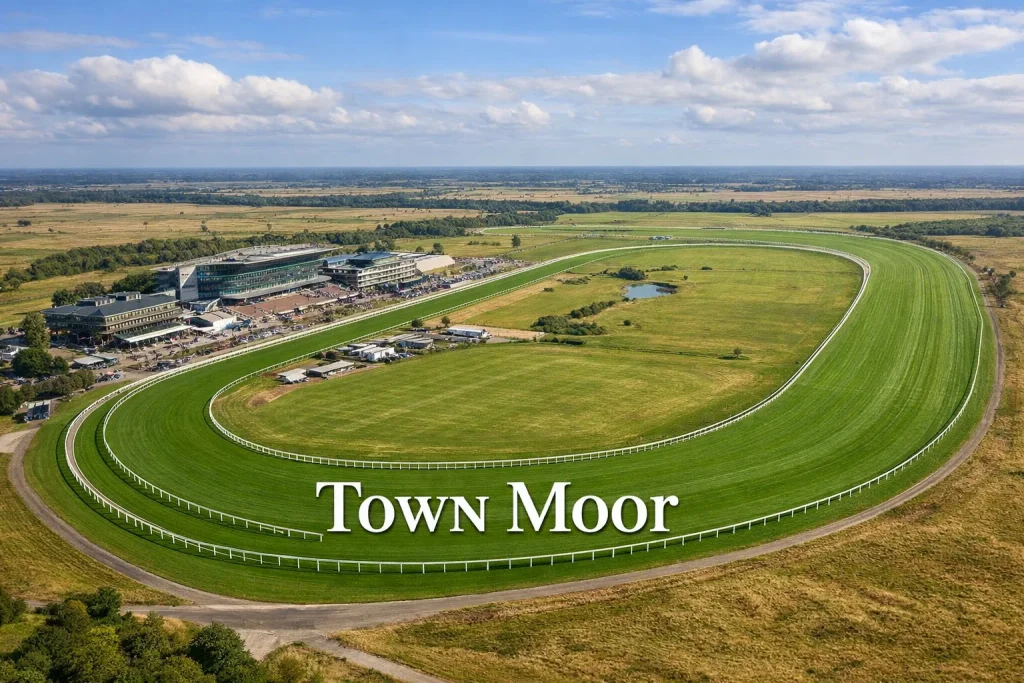
Doncaster Racecourse sits on Town Moor, a stretch of common land in South Yorkshire that has hosted horse racing since at least the seventeenth century. It is one of the largest and most historic racecourses in Britain, and its layout — flat, left-handed, with one of the longest home straights in the country — has shaped the character of every St Leger since the race moved here from Cantley Common in the 1770s.
For racegoers, Doncaster offers a combination of modern facilities and traditional atmosphere that few courses can match. The 2026 season will see the racecourse host 35 fixture days as part of the Festival of the Flat programme celebrating 250 years of the St Leger. Whether you are visiting for the first time or returning after a break, this guide covers the essential information: track characteristics that affect the racing, the stands and enclosures where you will watch it, and the practical details of getting there and parking.
Doncaster Racecourse Track: Left-Handed Layout for Stayers
Town Moor’s track is left-handed, roughly pear-shaped, and almost entirely flat. The round course measures approximately two miles in circumference, making it one of the most spacious tracks on the British flat circuit. The straight course, used for sprint races over five, six, and seven furlongs, runs alongside the home straight of the round course.
For the St Leger, run over one mile, six furlongs, and 115 yards, the start is on the round course. The field runs down a straight section, sweeps through a wide left-hand bend on the far side, continues along the back straight, and then turns into the home straight with nearly five furlongs still to race. That long run-in is the defining feature of the track. Five furlongs is an enormous distance to sustain a finishing effort — longer than many sprint races — and it rewards horses who can maintain their gallop rather than those who rely on a short burst of acceleration.
The width of the track is generous throughout. Doncaster does not produce the kind of traffic problems you see at tighter courses like Catterick or Beverley. Horses have room to manoeuvre, jockeys can switch position without losing ground, and the draw — the stall position at the start — has minimal impact over the St Leger distance. The course is designed for galloping, and galloping is what it rewards.
The ground at Town Moor is a sandy loam over clay subsoil. It drains reasonably well after light rain but can deteriorate quickly when rainfall is heavy or sustained. The flat topography means water does not run off naturally, and in wet Septembers the going can change from good to soft within a day. Doncaster’s groundstaff are experienced and proactive — they water in dry spells and manage drainage in wet ones — but the course’s natural characteristics mean that the going is always subject to the weather, particularly during the St Leger Festival.
Stands, Enclosures, and On-Course Facilities
Doncaster Racecourse underwent a significant redevelopment in the early 2000s, and the current facilities reflect that investment. The main grandstand is a modern structure with multiple levels of seating and standing areas, offering clear views of the home straight and the finishing line from most positions. The parade ring sits between the grandstand and the track, accessible to all enclosures, and provides the pre-race viewing area where racegoers can assess the horses before heading to the bookmakers.
The three main enclosures — County, Grandstand, and Lawn — cater to different budgets and preferences. The County Enclosure is closest to the parade ring and offers the most refined facilities, including a dedicated bar and dining area. The Grandstand provides a solid middle ground with good track views and proximity to the on-course betting ring. The Lawn is the most affordable option, with open-air standing areas and a relaxed atmosphere.
On-course betting facilities include both Tote windows and traditional bookmaker pitches in the betting ring. The bookmakers’ ring at Doncaster is one of the largest in the country, and on St Leger Day it is packed with layers offering prices on every race. For punters who prefer to bet in person rather than on an app, the atmosphere of the ring — the shouted prices, the chalked boards, the last-minute drift or shortening of odds — is part of the experience that a screen cannot replicate.
Food and drink options range from basic racecourse fare to seated restaurants. Hospitality packages are available for corporate groups and special occasions, typically including a reserved table, a meal, and access to the County Enclosure. The racecourse will host 35 fixture days in 2026 as part of its 250th anniversary programme, the most ambitious schedule in its modern history.
How to Get to Doncaster: Rail, Road, and Parking Options
Doncaster is well connected by both rail and road, though on St Leger Day — with more than 26,000 people converging on the racecourse — advance planning is essential.
By train, Doncaster station is on the East Coast Main Line, with direct services from London King’s Cross (approximately 90 minutes), Leeds (around 50 minutes), and Sheffield (roughly 25 minutes). From the station, the racecourse is about a mile and a half — a 25-minute walk or a short taxi ride. On St Leger Day, shuttle buses typically operate between the station and the course, though availability varies from year to year. Check the racecourse website for confirmed transport details closer to the event.
By car, the racecourse is accessible via the M18 motorway (junction 3 or 4) and the A1(M). Postcode for sat-nav is DN2 6BB. Parking at the racecourse is available but fills quickly on St Leger Saturday. Pre-booking is strongly recommended — on-the-day parking may not be available, or may involve walking a considerable distance from overflow fields. Expect traffic congestion on the approaches to the course from early morning, and plan to arrive well before the first race.
Alternative parking options include Doncaster town centre car parks, from which the racecourse is accessible on foot or by taxi. Some local residents offer private parking on St Leger Day, advertised on front-garden signs along the main approach roads — these tend to be cheaper than official parking but unregulated. If you use one, check that the location is a genuine short walk from the course, not a half-hour hike.
For those combining the St Leger with an overnight stay, Doncaster town centre has a range of hotels from budget to mid-range. Book early — rooms close to the racecourse fill up months in advance for the St Leger Festival, particularly in the 250th anniversary year.
