
Understanding St Leger Betting Odds and Markets
 Available in US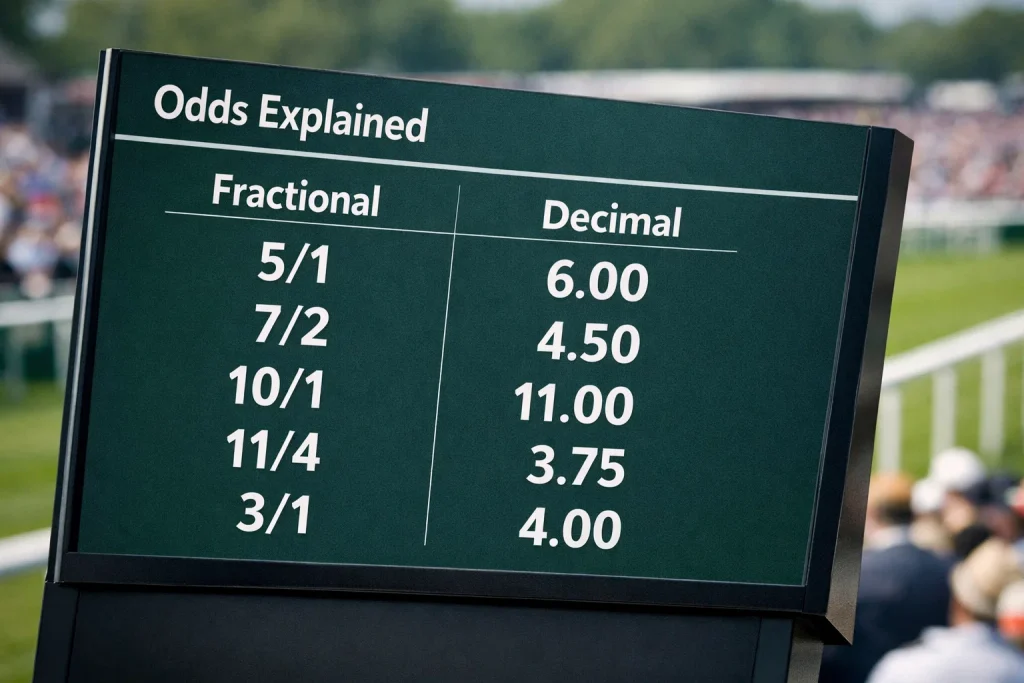
St Leger betting odds are quoted in three different formats, at three different moments in time, through three different types of market. If that sounds more complicated than it needs to be, you are not alone — the way horse racing prices are presented can confuse even regular bettors, and the St Leger’s long ante-post window makes it more layered than most races.
This guide explains the mechanics behind the numbers. Fractional and decimal odds are two ways of expressing the same price. Starting price and ante-post are two moments at which the price is fixed. Exchange and fixed-odds are two market structures with different rules. Understanding each one — and knowing when each matters most — gives you a practical advantage before the 250th St Leger at Doncaster in 2026.
St Leger Betting Odds: Converting Fractional and Decimal
Fractional odds are the traditional British format. A price of 5/1 means you receive £5 in profit for every £1 staked, plus your original stake back — so a £10 bet at 5/1 returns £60 total. A price of 2/1 returns £30 on a £10 bet. Evens (1/1) returns £20. Odds-on prices, such as 4/6, mean you stake more than you stand to win: £10 at 4/6 returns £16.67.
Decimal odds express the total return per unit staked. The decimal equivalent of 5/1 is 6.0 — multiply your stake by 6.0 to get the total return. The equivalent of 2/1 is 3.0. Evens is 2.0. The conversion formula is straightforward: divide the first number by the second, then add 1. So 5/1 becomes (5 ÷ 1) + 1 = 6.0. And 11/4 becomes (11 ÷ 4) + 1 = 3.75.
A quick reference for common St Leger prices: 1/2 fractional equals 1.50 decimal. Evens equals 2.00. 2/1 equals 3.00. 5/2 equals 3.50. 4/1 equals 5.00. 6/1 equals 7.00. 10/1 equals 11.00. 25/1 equals 26.00.
Each format also implies a probability. A horse at 4/1 (5.0 decimal) has an implied probability of 20% — calculated by dividing 1 by the decimal price. At evens (2.0), the implied probability is 50%. At 10/1 (11.0), it is roughly 9%. These implied probabilities do not sum to 100% across the full field — they sum to the over-round, which is the bookmaker’s built-in margin. But they give you a useful benchmark: if you believe a horse has a better chance than the odds imply, the bet has theoretical value.
Most UK bookmaker apps allow you to switch between fractional and decimal in the settings. Neither format is inherently better — decimal is arguably easier for calculating returns, fractional is more intuitive for British racegoers who grew up with the system. Choose whichever you find clearer, and make sure you can calculate your potential return before committing.
Starting Price vs Ante-Post: When the Odds Are Set
The starting price — SP — is the odds at which a horse is returned at the moment the race begins. It is the industry’s official benchmark price, calculated from the on-course bookmakers’ boards just as the stalls open. If you bet at SP, you accept whatever price the market settles on at the off — you do not know your exact return until the race starts.
Ante-post odds, by contrast, are fixed at the moment you place your bet. If you back a horse at 10/1 in March and it shortens to 2/1 by September, you still hold the 10/1 ticket. The potential reward for betting early is higher prices; the risk is that the horse may not run, in which case your stake is lost under standard ante-post rules.
The difference between SP and ante-post matters more for the St Leger than for most races, because the ante-post market is active for months before the off. Trial results, training reports, going forecasts, and entry decisions all cause prices to shift — sometimes dramatically — between the opening of the market and race day. A horse that is 8/1 ante-post in June might be 5/2 by September, or it might drift to 14/1 if a trial goes badly.
The over-round — the margin built into the bookmaker’s prices — applies differently to each market type. The average over-round in the St Leger SP market across the past twenty years is approximately 117%, according to analysis by OLBG. Ante-post markets tend to carry a higher over-round because the bookmaker is exposed to greater uncertainty: more horses in the market, more potential non-runners, and a longer time horizon during which anything can change. The flip side is that ante-post prices are often more generous on individual horses — the wider margin comes from the market’s breadth, not from each horse being priced shorter.
For punters deciding between SP and ante-post, the question is confidence. If you have a strong opinion on a horse and want to lock in a price before it shortens, ante-post delivers value — provided the horse actually runs. If you prefer to wait for final declarations, the going report, and the pre-race market moves, betting on the day at SP (or a fixed price taken shortly before the off) is lower-risk but typically at shorter odds.
Exchange Odds: Backing and Laying on the St Leger
Exchange betting — Betfair being the dominant platform in the UK — operates on a fundamentally different model from traditional bookmaking. On an exchange, you are not betting against a bookmaker; you are betting against other punters. You can back a horse (bet on it to win) or lay a horse (bet against it winning). The exchange takes a commission on winning bets — typically 2% to 5% — rather than building a margin into the odds.
For the St Leger, the exchange market usually opens earlier than most traditional bookmakers’ ante-post offerings. Prices are quoted in decimal format, and they fluctuate in real time as money comes in on both sides. A horse might trade at 8.0 (7/1) on Monday morning and 6.5 (11/2) by Monday evening if a positive training report surfaces. The volatility is higher than in fixed-odds markets, but so is the transparency — you can see exactly how much money has been matched at each price.
Alex Frost, CEO of the UK Tote Group, has pointed out that horse racing betting carries three additional layers of cost: betting duty, the responsible gambling levy, and the horserace betting levy. Those costs are built into the prices offered by traditional bookmakers. Exchange odds, by contrast, are set by the market — by punters backing and laying against each other — which means the odds often come closer to the true implied probability of each outcome. The exchange commission partially offsets this advantage, but for serious bettors the effective margin on an exchange is usually lower than on a fixed-odds site.
The UK horse racing online betting market generated £8.73 billion in turnover during the 2023–24 financial year, according to Gambling Commission data — a figure that includes both exchange and fixed-odds activity. That volume ensures deep liquidity in major races like the St Leger, meaning you can usually get matched at close to the current best price without significant slippage.
For punters new to exchange betting, the St Leger is a good race to start with: the small field means fewer options to evaluate, the market is liquid enough to enter and exit positions, and the long ante-post window allows you to observe how exchange prices move before committing your money.
