
UK Horse Racing Betting Market in 2026: Turnover, Regulation, and the Premium Shift
 Available in US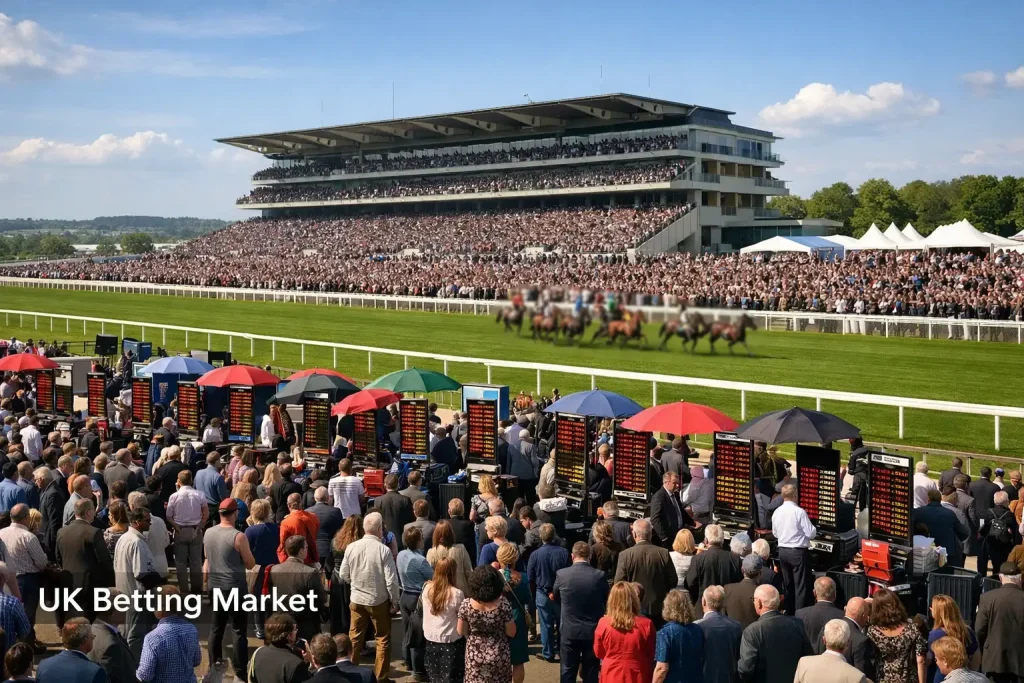
The UK horse racing betting market in 2026 is valued at approximately £3.7 billion, encompassing around 499 companies across the betting and gaming sector. That headline figure sits within a broader landscape of declining overall turnover, tightening regulation, and a structural shift in where the money goes. Bettors are spending less on horse racing as a whole — but they are spending more on the races that matter most.
For anyone betting on the St Leger or any other premium flat fixture, this macro picture is not abstract. It shapes the odds you are offered, the margins bookmakers build into their prices, and the competitive dynamics of the markets you trade in. Understanding the industry’s financial health helps explain why some races attract sharper markets than others, and why the St Leger — as one of British racing’s marquee events — occupies an increasingly privileged position in the betting ecosystem.
The Numbers: How Betting Turnover on Racing Has Shifted
Online betting turnover on horse racing in the UK reached £8.73 billion in the 2023–24 financial year, according to Gambling Commission data. That sounds substantial, but the trajectory is downward: turnover was over £10 billion just two years earlier, representing a decline of 16.3% in nominal terms. Adjusted for inflation, the real decline is closer to 26%. British punters are, in aggregate, betting less on horse racing than they were at the start of the decade.
The BHA’s own data confirms the trend from the racing side. Overall betting turnover on British racing fell 4.3% in 2025 compared to 2024, and by 10.7% compared to 2023. The average turnover per race dropped 5.6%, reflecting both fewer bets per race and, in some cases, fewer races being run at all.
The gross gambling yield — GGY, the amount bookmakers retain after paying out winners — for horse racing in the remote (online) sector was £766.7 million in the 2024–25 financial year, according to Gambling Commission data. That figure is part of a total remote GGY of £2.6 billion across all gambling products. Horse racing’s share of the overall pie has been declining as other products — particularly in-play football betting and casino games — capture a larger proportion of the online gambling market.
These numbers matter for punters because turnover drives liquidity, and liquidity drives the competitiveness of odds. When less money flows into horse racing markets, bookmakers have less need to compete aggressively on price. The over-round — the margin built into the odds — can creep up without punters noticing, because there is less pressure from sharp money to push prices towards fair value. A market that turns over £1 million on a single race is inherently more competitive than one that turns over £100,000.
The decline in overall turnover is not uniform across the calendar. Major festivals — Cheltenham, Royal Ascot, the Derby, the St Leger — have held their ground or even grown in turnover terms, while the everyday programme has borne the brunt of the contraction. This bifurcation is central to understanding the current market: the aggregate numbers look weak, but the specific markets that matter most to informed punters remain healthy.
From a broader industry perspective, the UK horse and sports betting market was valued at £3.7 billion in 2026 according to IBISWorld, with a compound annual growth rate of effectively zero over the past five years. The market is not collapsing, but it is not growing either — it is redistributing. The money that once spread across thousands of races per year is now funnelling into a smaller number of premium events, where the betting product is sharper, the media coverage is greater, and the punter’s experience is more engaging.
Regulation and the Levy: Where the Industry’s Money Flows
The financial architecture of British horse racing is funded through a complex system of levies, contributions, and government oversight that directly affects the betting experience.
The Horserace Betting Levy Board allocated £77.1 million for 2026, including an additional £4.4 million directed specifically at prize money. This funding supports racecourse infrastructure, veterinary services, and the prize funds that attract owners and trainers to run their horses at British tracks. Without the levy, many races — including some at the St Leger Festival — would carry significantly lower purses, attract weaker fields, and offer less compelling betting markets.
Total prize money across British racing reached a record £194.7 million in 2025, with racecourses contributing £103.4 million, the Levy Board providing £63.2 million, and owners themselves funding £26.8 million. The record figure is encouraging, but it masks a concentration of investment at the top: the biggest prizes go to the biggest races, and the gap between premier fixtures and everyday cards is widening.
Alex Frost, CEO of the UK Tote Group, has highlighted that horse racing betting operators face three additional layers of cost that do not apply to other gambling products: betting duty, the responsible gambling levy, and the horserace betting levy. These costs are ultimately passed through to punters in the form of less competitive odds. The three-layer cost structure is one reason why horse racing markets tend to carry higher over-rounds than, say, Premier League football, where the betting product is subject to fewer sector-specific charges.
For punters, the regulatory framework is largely invisible in day-to-day betting. But it explains why the St Leger market’s average over-round of 117% is higher than what you might find on a Champions League match, and why odds comparison across multiple bookmakers is not merely a good habit but a necessary one. The three-layer cost structure is embedded in every price you see, and the only way to mitigate its effect on your returns is to shop for the best available number.
The Premium Shift: Why Big Races Now Attract a Bigger Share
The most significant structural trend in the UK horse racing betting market is what the BHA calls the “premium shift.” BHA data from Q3 2025 shows that average betting turnover per race at Premier Fixtures — the category that includes the St Leger, Royal Ascot, the Derby, and other flagship events — rose by 2.7% in 2025. Over the same period, turnover at Core Fixtures — the everyday racing cards that make up the bulk of the schedule — fell by 8.6%.
The divergence is stark. Bettors are not simply betting less on horse racing — they are concentrating their money on the events they care about most and withdrawing from the midweek cards that do not generate the same level of interest or media coverage. The premium shift has accelerated since the pandemic, when the proliferation of online betting made it easier for casual punters to follow major events without engaging with the everyday product.
For the St Leger specifically, the premium shift is good news. More money flowing into the Leger market means tighter odds, more competitive pricing, and more liquidity for punters who want to back or lay at exchange prices. It also means the race attracts attention from sharper bettors — the kind who study form, compare odds, and move markets with informed money. A well-analysed St Leger position has a better chance of finding a counterparty at a fair price than it would in a quieter market.
The longer-term context is less comfortable. The BHA forecasts that the total number of races run in Britain will be 6–7% lower in 2027 than in 2024, reflecting the declining horse population and the economics of staging fixtures with smaller fields. Fewer races means fewer betting opportunities outside of the premium events, which reinforces the concentration trend. The St Leger — as one of racing’s crown jewels — will continue to attract money. The races around it, on the undercard and on other days, may face a quieter market.
For punters, the takeaway is strategic: invest your time and your bankroll in the races where the market is deepest and the form is most readable. The St Leger sits squarely in that category. The premium shift is not just an industry trend — it is a signal about where the best betting value is likely to be found.
