
Fillies in the St Leger: Eligibility, Historical Winners, and the Park Hill Alternative
 Available in US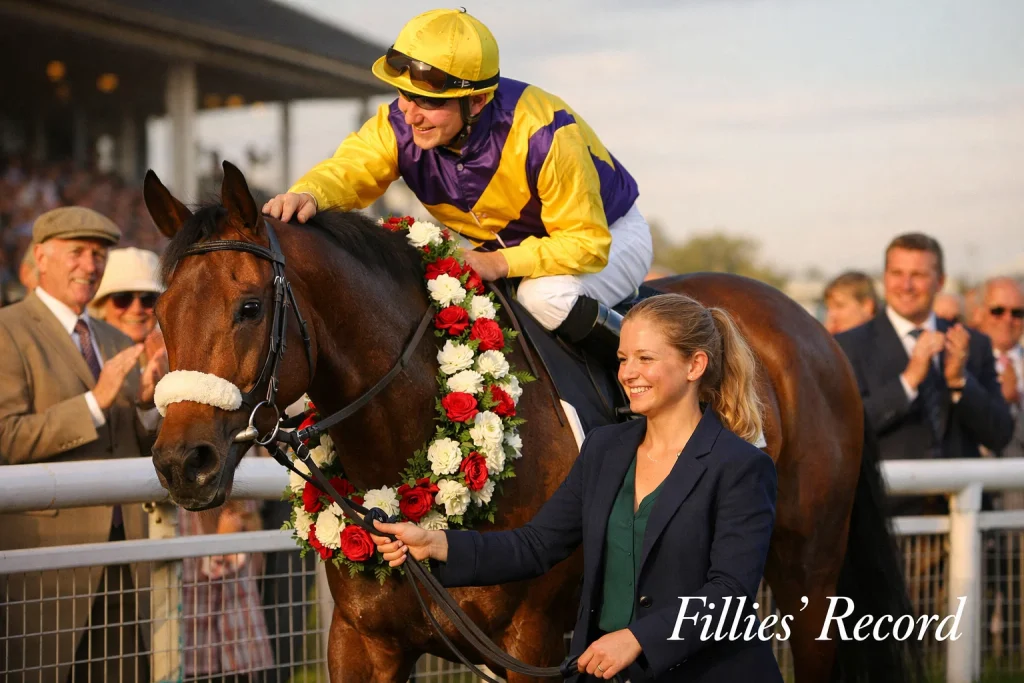
Fillies can run in the St Leger, they receive a weight allowance when they do, and they have won it. That combination of facts surprises many casual racing followers, who assume the world’s oldest Classic is restricted to colts and geldings. It is not. The St Leger is open to all three-year-old Thoroughbreds regardless of sex, and the fillies who have taken on the colts over the years include some of the most celebrated names in the breed’s history.
Whether a filly should run in the St Leger — rather than the Park Hill Stakes, the fillies-only equivalent staged at the same festival — is a different question entirely, and one that trainers weigh carefully every September. This guide explains the eligibility rules, reviews the historical record, and describes the Park Hill as the alternative route for staying fillies at Doncaster.
Entry Rules: How Fillies Compete Against Colts
The St Leger’s conditions are straightforward: it is a Group 1 Stakes for three-year-old colts, fillies, and geldings, run over one mile, six furlongs, and 115 yards. Fillies who enter receive a sex allowance of three pounds — meaning they carry 8st 9lb compared to the colts’ 9st. That three-pound concession is designed to account for the general physical difference between male and female Thoroughbreds at three years of age, and it is a standard feature of mixed-sex flat races worldwide.
The entry process is identical for fillies and colts. According to William Hill News, the three-stage registration system — initial entry at £2,000, second stage at £3,000, final confirmation at £2,000 — applies regardless of sex, as does the supplementary entry option at £50,000 for horses not originally nominated. There is no additional hurdle or separate qualification pathway for fillies. If a trainer believes a filly can win the St Leger, the door is open.
In practice, very few fillies contest the St Leger in the modern era. The reasons are commercial and practical rather than regulatory. A three-year-old filly with staying ability has a lucrative career as a broodmare ahead of her, and connections are often reluctant to risk that future on a gruelling race against colts. The Park Hill Stakes — run at the same festival over the same distance, but restricted to fillies — offers Group 2 prize money and black type without the risk of defeat by physically stronger male rivals. Most trainers choose the Park Hill.
When a filly does line up in the St Leger, it is a statement of exceptional confidence. The trainer believes the filly is not just the best of her sex but competitive against the best colts in training. That confidence is worth noting as a punter: a filly entered in the Leger rather than the Park Hill has been assessed internally as a genuine contender, and trainers rarely make that call lightly.
Fillies Who Won the St Leger: From Meld to Sun Princess
The roll of filly winners in the St Leger is short but distinguished. Meld (1955), trained by Cecil Boyd-Rochfort and ridden by Harry Carr, won the St Leger as part of a Classic treble that also included the 1000 Guineas and the Oaks — making her the last filly to complete what is sometimes called the Fillies’ Triple Crown in the same year as a St Leger victory.
Sun Princess (1983), trained by Dick Hern, won the St Leger by a dozen lengths — one of the most emphatic victories in the race’s modern history. Her dominance was so complete that the margin rendered the colts an afterthought, and she remains one of the most visually impressive St Leger winners of the television era.
Oh So Sharp (1985), trained by Henry Cecil and ridden by Steve Cauthen, completed the Fillies’ Triple Crown — 1000 Guineas, Oaks, and St Leger — becoming the first filly to achieve that feat since Meld thirty years earlier. Her St Leger victory at Doncaster was not the most convincing of her three Classic wins — she hung right in the closing stages and won by three-quarters of a length from Phardante — but it was enough to seal the treble and confirm that she remained, as Cauthen would later describe her, the best filly he ever rode. As of 2026, Oh So Sharp remains the most recent filly to complete the Fillies’ Triple Crown.
Since then, filly participation in the St Leger has been rare. Aidan O’Brien’s approach is instructive: when he has a top-class staying filly — such as Minding, who won the 1000 Guineas and Oaks in 2016 but was kept to fillies-only targets rather than risking the Leger against the colts — the decision between the Leger and an alternative route is made on an individual basis. O’Brien’s nine St Leger victories have all come with colts, reflecting the general trend away from running fillies in mixed company over extreme distances.
For punters, the key takeaway is that a filly in the St Leger field is an unusual event, and the market typically prices her with scepticism. Historically, that scepticism has sometimes been misplaced — Sun Princess was not sent off as favourite and won by a street. If a filly with genuine form enters the 2026 St Leger, the odds may overestimate the disadvantage of her sex and underestimate the ability that prompted the entry.
The Park Hill Stakes: The Fillies’ Alternative at Doncaster
The Park Hill Stakes is a Group 2 race for three-year-old fillies, run over the same distance as the St Leger — one mile, six furlongs, and 115 yards — during the St Leger Festival. It is, in effect, the fillies’ St Leger, and it attracts the staying fillies who would otherwise need to take on the colts in the main race.
The Park Hill’s prize money is lower than the St Leger’s, and its Group 2 status carries less weight in a broodmare’s profile than a Group 1 victory would. But it offers a realistic chance of winning a prestigious staying race at Doncaster without the physical risk of racing against colts over an extreme distance. For owners planning a filly’s breeding career, the Park Hill represents the sensible option — a black-type victory that protects the horse’s long-term value.
The race is part of Doncaster’s 35-fixture 2026 programme and is typically staged on the Thursday or Friday of the festival. It draws fields of eight to twelve runners, making it a competitive each-way betting heat with more market depth than the St Leger itself in some years. Punters who enjoy staying races should not overlook the Park Hill — it often features future Group 1 fillies running at a level where their price underestimates their ability.
The coexistence of the Park Hill and the St Leger at the same meeting creates a natural fork for trainers of staying fillies. The choice a trainer makes — Leger or Park Hill — tells you something about how they rate the filly relative to the colts. When that choice is the Leger, pay attention.
