
St Leger Forecast and Tricast Betting: How Multi-Place Wagers Work
Best Horse Racing Betting Sites – Bet on Horse Racing in 2026
Loading...
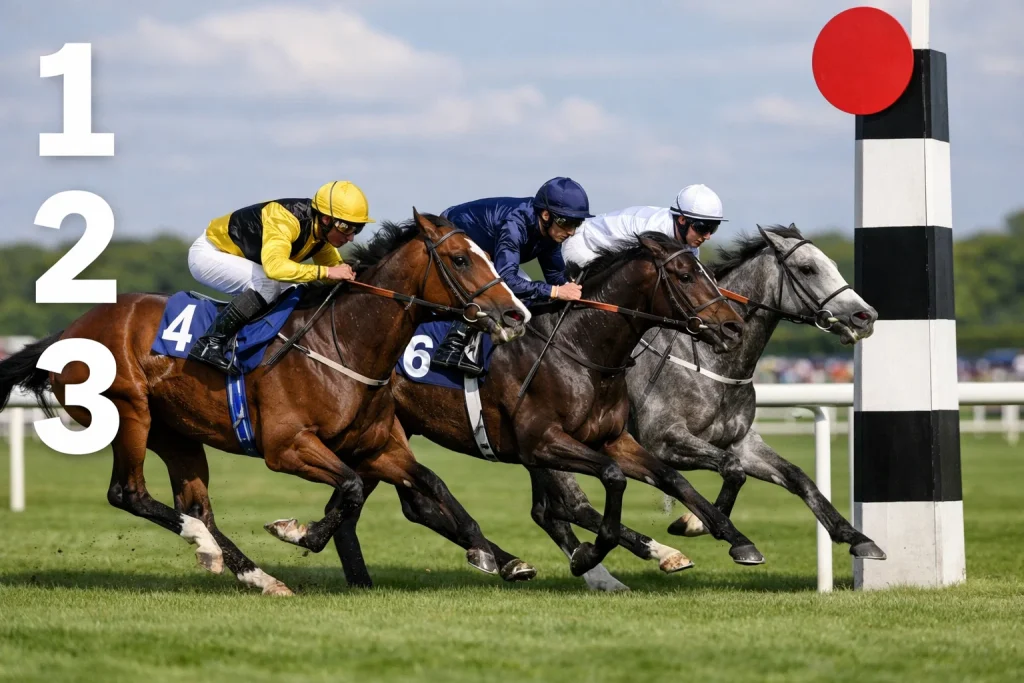
St Leger forecast and tricast betting asks you to predict more than just the winner. A forecast requires you to name the first and second horses in the correct order. A tricast extends that to first, second, and third. The payouts can be substantial — far larger than a simple win bet — but the difficulty scales accordingly. You are not just picking a horse that performs well; you are picking an exact finishing sequence.
These are exotic bets by any definition, and they are not for everyone. But the St Leger has characteristics that make forecasts and tricasts more viable here than in most races: small fields, predictable form patterns, and a market where the top three in the betting finish in the top three on the course with remarkable regularity. If there is a Group 1 flat race where exotic bets have a rational basis, this is it.
How Forecasts Work: Picking First and Second
A forecast bet comes in two forms: straight and reverse. A straight forecast requires you to name the first and second finishers in the exact order. Horse A wins, Horse B finishes second — only that combination pays out. If Horse B wins and Horse A finishes second, a straight forecast loses.
A reverse forecast covers both permutations: A-B and B-A. It costs twice as much as a straight forecast because it is, in effect, two bets. The advantage is that you do not need to predict which of your two selections wins and which runs second — you just need both to occupy the first two places in either order.
The payout for a forecast is calculated by the computer straight forecast, or CSF. Unlike fixed-odds bets, where the price is agreed at the time you place the bet, the CSF is determined by the starting prices and finishing order on the day. This means you do not know your exact return until after the race. In general, a forecast pays significantly more than a win bet on the same horse, because you are predicting a more specific outcome.
For the St Leger, forecasts become particularly interesting when viewed against the historical data. Ten of the last twelve winners were among the top three in the betting market. That means the top of the market is reliably producing the first finisher. If you can also identify the likely second — perhaps the second favourite, or a horse with strong place form — the forecast becomes less of a lottery than it appears.
A practical example: in a seven-runner St Leger where the favourite is 2/1 and the second favourite is 7/2, a straight forecast combining those two might return anywhere from 8/1 to 15/1 depending on the exact CSF calculation. That represents a significant uplift on a simple win bet at 2/1, for the additional risk of also predicting the runner-up.
Tricast Bets: First, Second, Third in the Correct Order
A tricast extends the principle to three places: you name the first, second, and third finishers in the exact order. Like a forecast, it can be placed as a straight tricast (one specific combination) or as a combination tricast (all possible orderings of your three selections).
The maths on permutations matters here. Three horses can finish in six different orders (3 x 2 x 1 = 6). A combination tricast therefore costs six times your unit stake. If your unit stake is £1, a combination tricast costs £6. If you want to include four horses in a combination tricast, the permutations rise to 24 (4 x 3 x 2), and the cost jumps to £24.
Field size directly affects the number of possible tricast outcomes and, consequently, the likely payout. The 2025 St Leger had seven runners. In a seven-runner race, the total number of possible tricast combinations is 210 (7 x 6 x 5). In a twelve-runner race, that number rises to 1,320. Fewer possible outcomes means a smaller pool of losing combinations for the bookmaker to absorb, which typically translates to lower tricast payouts in small fields compared to large ones.
This creates a trade-off that is specific to the St Leger. The smaller field makes it easier to identify the likely top three — with ten of twelve recent winners coming from the top three in the betting, the form patterns are unusually predictable. But the reduced field also means the payout is lower relative to a handicap with twenty runners where the tricast might return hundreds to one. In a seven-runner St Leger, a straight tricast combining the three market leaders might pay between 15/1 and 40/1, depending on their individual starting prices.
The question for punters is whether that payout justifies the risk. Predicting three horses in exact order remains difficult even in a small field, and a tricast that narrowly misses — correct horses, wrong order — returns nothing. Combination tricasts mitigate this by covering all orderings, but they multiply the stake accordingly.
When Forecast and Tricast Bets Make Sense in the Leger
Forecast and tricast bets make the most sense in the St Leger when three conditions align: a small field, a dominant favourite, and a confident second pick.
The small-field condition is usually met. Recent St Legers have attracted between seven and twelve runners, well below the maximum for a flat race. Fewer runners means fewer possible combinations, which means each combination carries a higher implied probability and is easier to assess rationally. In a twenty-runner handicap, a forecast is essentially a lottery ticket. In a seven-runner Classic, it is a structured bet with identifiable edges.
The dominant-favourite condition narrows the first leg. If the favourite is a genuine 6/4 or shorter — as Hurricane Lane was in 2021 at 5/6 — the win portion of a forecast is relatively secure. The value then comes from identifying the runner-up or third. This is where form analysis pays its way: a horse with consistent place form, ideally from a recognised trial, becomes a strong forecast partner alongside the market leader.
Alex Frost, CEO of the UK Tote Group, has noted that horse racing betting carries three additional layers of cost compared to other gambling products: betting duty, the responsible gambling levy, and the horserace betting levy. Those costs are baked into the over-round — the average margin in the St Leger market sits at 117% over the past two decades. Forecast and tricast bets sidestep some of that margin because the CSF is calculated from starting prices rather than from the bookmaker’s pre-set odds. In races where the over-round is high, the CSF can sometimes offer better effective value than a straight win bet at the bookmaker’s price.
That said, exotic bets should represent a small portion of any St Leger betting budget. They are high-risk by nature, and even the most predictable St Leger can produce a surprise in the minor places. Use forecasts when you have a strong opinion on both winner and runner-up. Use combination tricasts when you have three horses you are confident will fill the frame, regardless of order. In all other cases, a win or each-way bet remains the more rational choice.