
St Leger Going and Ground Conditions: How Doncaster's Turf Shapes Results
Best Horse Racing Betting Sites – Bet on Horse Racing in 2026
Loading...
The going at Doncaster on St Leger day is the invisible variable that reshapes betting markets in the final forty-eight hours before the off. A horse priced at 3/1 on Monday can drift to 6/1 by Saturday morning if the heavens open, and a rank outsider on quick ground can become a serious contender when the rain arrives. St Leger going and ground conditions matter more here than in almost any other British Classic, because the race’s extreme distance — one mile, six furlongs, and 115 yards — amplifies the effect of every degree of softness or firmness underfoot.
Town Moor’s turf in September is unpredictable by nature. The course sits on flat, low-lying ground in South Yorkshire, exposed to whatever weather systems roll in from the west. The going can change from good to firm on the Wednesday of the festival to soft by Saturday afternoon. Understanding how that turf behaves, and what different conditions demand from a staying three-year-old, is one of the most practical edges a punter can develop.
Town Moor’s Terrain: Drainage, Soil, and What September Brings
Town Moor is one of the largest racecourses in Britain, set across open common land that has hosted racing since the eighteenth century. The track is left-handed, essentially pear-shaped, with long straights and wide, sweeping bends. The home straight extends for nearly five furlongs — one of the longest in flat racing — which gives jockeys and horses ample room to manoeuvre in the final stages.
The soil beneath the turf is a mix of sandy loam and clay subsoil, and its drainage characteristics are central to how the going behaves. Sandy loam drains relatively well after light rain, which is why Doncaster can race on good ground even after a morning shower. But the clay layer underneath acts as a barrier when rainfall is heavy or sustained. Once the topsoil saturates, the water has nowhere to go, and the ground deteriorates quickly from good to soft to heavy. Doncaster’s groundstaff are among the most experienced in the country, and they water or leave the ground according to forecasts, but in September the British weather has the final say.
The course’s flat topography compounds the drainage issue. There is virtually no natural gradient to carry water away from the racing surface. On hillier tracks like Epsom or Goodwood, gravity assists drainage. At Town Moor, standing water can accumulate in the lower sections of the course, particularly on the far side of the track away from the grandstands. Horses racing through those patches expend more energy than their rivals who find a drier path, and over a mile and six furlongs, that energy deficit can prove decisive.
September weather patterns in South Yorkshire are historically variable. Average rainfall for the month is around 50mm, but individual years swing widely. The 2019 St Leger was run on good ground after a dry late summer. The 2025 edition took place on soft going following persistent rain in the week before the festival. Punters who wait until the going is officially declared before committing their stakes gain a meaningful informational advantage over those who bet ante-post without factoring in conditions.
How Different Ground Conditions Affected Past St Legers
The last twenty St Legers provide a useful dataset for understanding how ground conditions affect results. The going has ranged from good to firm (2011, 2013, 2015, 2024) through good (2006, 2007, 2010, 2012, 2014, 2017, 2019) to good to soft (2008, 2016, 2020, 2021, 2022) and soft (2025). No modern St Leger has been run on officially heavy ground, though some soft renewals have featured patches that rode close to it.
On quicker ground — good to firm or good — the St Leger tends to be a more tactical affair. The pace is controlled, the field stays closer together for longer, and the race is often decided by acceleration in the final two furlongs rather than by sustained grinding from the front. Logician’s victory in 2019, run on good ground, was a textbook example: Frankie Dettori held him up in midfield, asked him to quicken entering the final furlong, and he pulled clear with the authority of a horse who was simply faster than his rivals on the day.
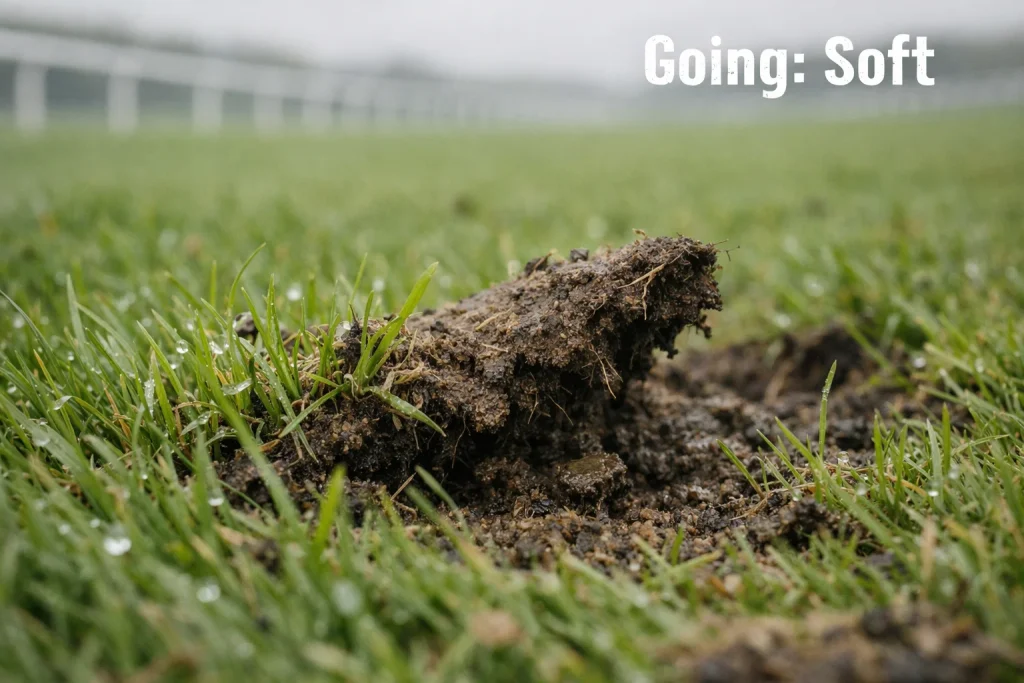
On softer ground, the complexion changes entirely. Stamina becomes the dominant factor, pace typically increases because front-runners know that sitting behind on testing ground costs more energy than pressing on, and horses with a proven ability to act in the mud pull clear earlier and more decisively. Scandinavia’s 2025 victory on soft ground followed that pattern — he raced prominently, kept finding when others tired, and won with the controlled power of a horse whose stamina was never in doubt.
The favourite strike rate — six out of twelve over the last dozen years — does not shift dramatically between going types, largely because bookmakers adjust their prices based on conditions. What does shift is which favourites win. On good ground, the market tends to favour horses with tactical speed, and those horses usually deliver. On soft ground, the market sometimes overprices speed horses and underprices confirmed mudlarks. That mispricing is where the value lies for punters who track going preferences closely. It is worth noting that the population of horses in training in Britain has been declining at roughly 1.5% per year since 2022, standing at 15,070 in early 2025 — a trend that shrinks St Leger field sizes and makes going conditions even more influential, since fewer runners mean less form data to work with on each ground type.
Identifying Horses Who Thrive When the Ground Turns
Identifying a horse who will handle the ground at Doncaster is part science, part pattern recognition. The science starts with breeding. Sires who consistently produce offspring that act on soft ground — Galileo being the most obvious example in the modern era — transmit stamina and a tolerance for heavy going through their bloodlines. A horse by Galileo or his sons (Australia, Frankel when paired with staying mares) is more likely to cope with cut in the ground than one by a speed-focused sire like Dubawi or Dark Angel.
But breeding alone does not guarantee going preference. The best indicator is past performance. A horse that has won or run well on soft ground at any point in its career has demonstrated the physical capacity to handle those conditions. Conversely, a horse whose entire form line is on good or faster ground is an unknown on softer surfaces. Data from HorseRacing.guide shows that nine of the last twelve St Leger winners had raced within 65 days of the Leger — meaning their most recent runs are usually current enough to provide a reliable indicator of going preference.
Physical indicators can help too. Horses who cope well with soft ground tend to have a higher action — lifting their knees higher with each stride to clear the surface — and a longer, more economical stride pattern. Compact, low-moving horses who skim the ground on fast surfaces often struggle when the turf turns soft because their stride mechanics are less suited to pulling their hooves free from a holding surface. Watching a horse’s action in the preliminaries on the day — or reviewing video of its most recent start on comparable going — can provide a final data point before you commit.
The practical approach for the 2026 St Leger is straightforward: monitor the forecast from mid-week, check the official going declaration on the morning of the race, and cross-reference each runner’s form on that type of ground. If the going is soft and a runner has never encountered anything slower than good, treat that horse with caution regardless of its price. The turf at Town Moor does not care about reputation. It rewards horses who can handle it, and it exposes those who cannot.