
St Leger 2026 Favourite: Early Market Leader Analysis and Form Pointers
 Available in US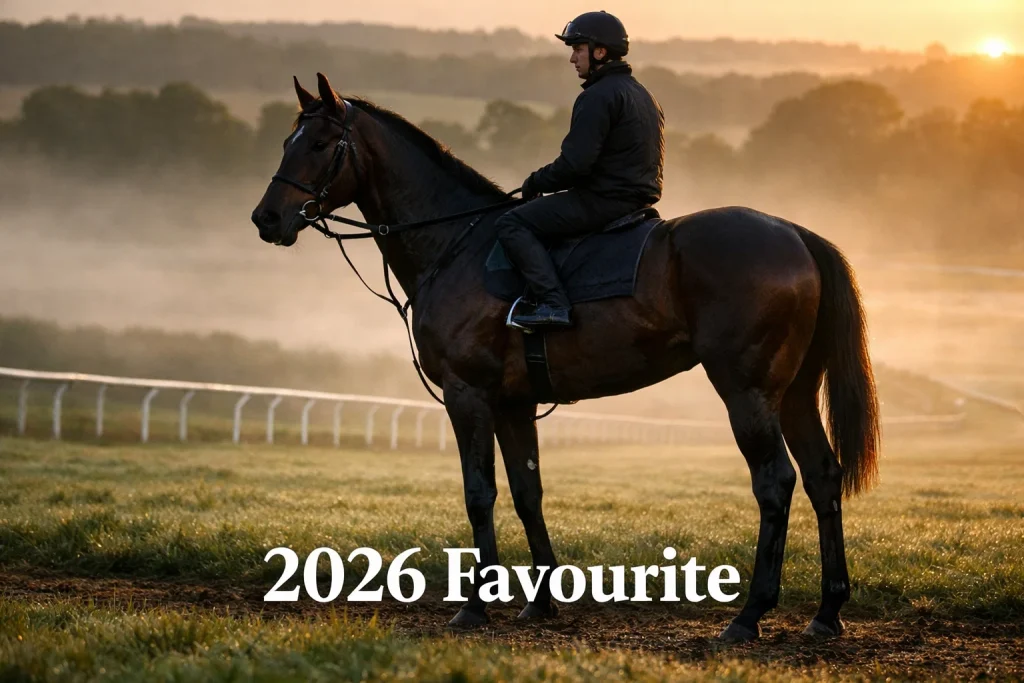
The St Leger 2026 favourite in March is rarely the same horse that heads the market in September. Ante-post markets for the world’s oldest Classic are shaped by speculation, training reports, and breeding assumptions — not by hard evidence from trials. The horse at the top of the list today may not even run at Doncaster. The horse that wins may not yet be in the market at all.
That fluidity is what makes the early ante-post market both dangerous and potentially rewarding. Back the right horse before the trials confirm its credentials, and you lock in a price that the September market cannot match. Back the wrong one, and your stake disappears — either to a non-runner or to a rival who produces better form when it matters. This page tracks the 2026 St Leger ante-post favourite as the season develops, and provides the form framework for evaluating whether the market leader deserves its position.
Who Heads the 2026 Ante-Post Market Right Now
As of spring 2026, the St Leger ante-post market is in its earliest phase. Most bookmakers have priced a handful of prominent three-year-olds based on their two-year-old form and their Classic entries, but the market is thin — prices are wide, liquidity is low, and the over-round is inflated because the field is undefined.
This section will be updated with specific horses and prices as the market takes shape through the spring and summer. For now, the structural question is more useful than the individual names: what kind of horse tends to head the St Leger ante-post market, and how often does that horse actually win?
The data provides a clear answer. Six of the last twelve St Leger favourites won the race. That is a 50% strike rate — significantly better than the average for Group 1 flat races in Britain, where the favourite wins roughly 30-35% of the time. The St Leger’s higher favourite success rate reflects the small field sizes, the relative predictability of staying form, and the dominance of a small number of powerful stables.
Ten of those twelve favourites finished in the top three — an 83% place rate that makes the market leader a reliable each-way proposition even if it does not win. For punters assessing the 2026 favourite, this historical backing is encouraging: the horse at the top of the market has a better-than-even chance of winning and an excellent chance of finishing on the podium.
The caveat is price. A favourite at 6/4 who wins 50% of the time is only marginally profitable over a large sample. The value in the St Leger favourite tends to appear earlier in the ante-post cycle, when the eventual market leader can be backed at 4/1 or longer before its trial form compresses the price. If you can identify which horse the market will settle on as favourite — before the market does — the returns justify the risk.
History provides a shortcut. In six of the last nine St Legers, the favourite has been trained by Aidan O’Brien. His nine St Leger victories — including three consecutive wins from 2023 to 2025, the first such streak in the race’s 249-year history — mean that when the Ballydoyle operation declares a clear number-one contender for the Leger, the market typically installs that horse at the top. Monitoring O’Brien’s stable plans from June onwards is the single most efficient way to anticipate who the September favourite will be.
Key Trial Entries for the Current Favourite
The current market leader’s trial entries — or lack of them — provide the first concrete evidence of intent. In the St Leger context, three trials matter most: the Gordon Stakes at Goodwood (late July), the Great Voltigeur at York (mid-August), and the Irish Derby at the Curragh (late June). A horse entered for one or more of these is being actively targeted at Doncaster. A horse with no trial entry may still run in the Leger, but the preparation is less transparent.
The Great Voltigeur has historically been the most direct pipeline. Four of the last twelve St Leger winners came through York, and fifteen horses in total have completed the Voltigeur–Leger double. If the current ante-post favourite is entered for the Voltigeur, that is a strong confirmation of intent. If it is aimed elsewhere — the Irish Champion Stakes, for example, or a French Group 1 — the Leger may not be the primary target, and the market may be pricing in a horse that ultimately runs at Longchamp instead.
Trial entries for the 2026 season will be listed here as they are confirmed. In the meantime, monitor trainer statements and racing press for indications of target races. Aidan O’Brien, who has won three consecutive St Legers, typically signals his intentions through the entry stages rather than through public statements. If a Ballydoyle horse remains engaged at each successive St Leger entry stage, and a supplementary entry is not required, the commitment is embedded in the process.
Three Form Angles to Watch Between Now and September
Three form angles consistently separate genuine St Leger contenders from market speculation. Apply them to the current favourite — and to any challenger — as the summer progresses.
The first is recent winning form. Seven of the last twelve St Leger winners had won their most recent start before Doncaster. According to HorseRacing.guide, this is the single strongest predictor of St Leger success. A horse arriving at Doncaster off a defeat can still win, but the probability drops measurably. When the current favourite runs in its final trial, the result matters more than anything else in the form book — a win confirms the preparation is working; a defeat raises questions that cannot be answered until race day.
The second is the 65-day window. Nine of the last twelve winners had raced within 65 days of the St Leger. A horse on a longer lay-off carries a fitness question that no amount of training gallop data can fully resolve. Check when the favourite last ran, and count the days to the Leger. If the gap exceeds nine weeks, the risk increases — not dramatically, but enough to factor into your assessment.
The third is distance experience. No horse in the modern era has won the St Leger without at least one run beyond ten furlongs. The favourite’s form over a mile and a half or further is not optional background information — it is a qualifying criterion. A horse whose entire career has been over a mile and a quarter, however talented, is an unproven stayer at the Leger distance. The market may price it as the best horse in the race, but the distance may prove otherwise.
These three filters — recent win, recent race, proven distance — will be applied to every horse on this page as the 2026 season develops. Any horse that passes all three warrants serious consideration. Any horse that fails two or more is a risk, regardless of where it sits in the betting.
