
Responsible Gambling for Horse Racing Bettors: Tools, Limits, and UK Support
 Available in US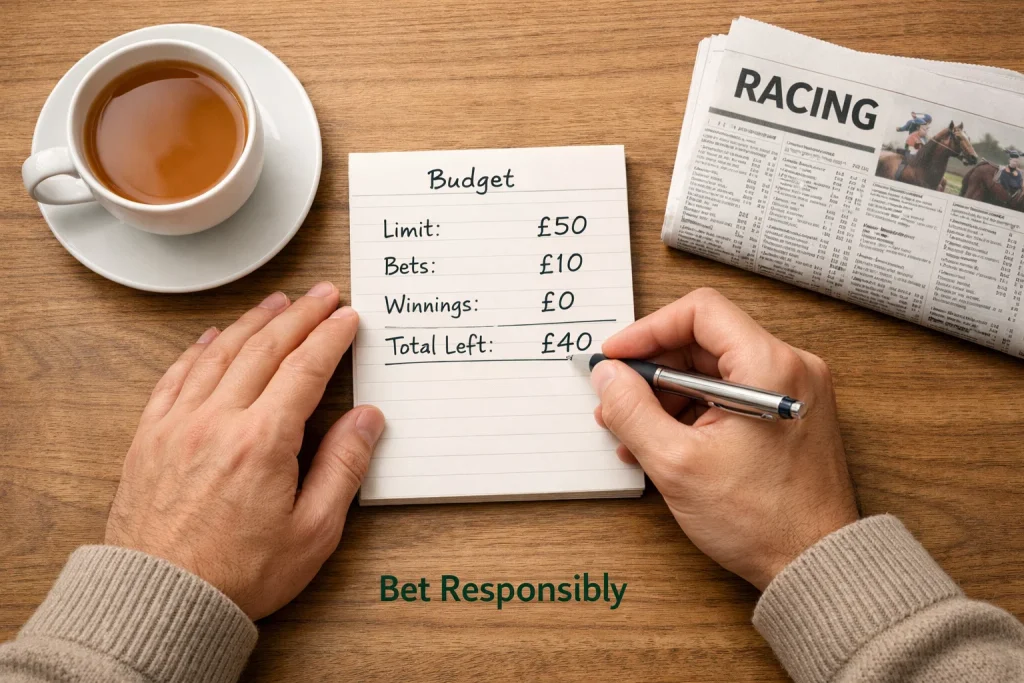
An estimated £4.3 billion is staked annually on the UK’s unlicensed black market in online gambling. That figure, drawn from a Frontier Economics report for the Betting and Gaming Council, represents 1.5 million British bettors choosing operators that sit outside the regulatory framework — no deposit limits, no self-exclusion tools, no guaranteed payouts, and no accountability when things go wrong.
Responsible gambling for horse racing starts with a simple decision: use a licensed bookmaker. Everything else — the deposit limits, the time-outs, the support resources — flows from that choice. A licensed operator is legally required to offer you the tools to manage your betting. An unlicensed one is not required to offer you anything except a way in.
This guide explains why licensed bookmakers matter, what responsible gambling tools are available, and where to find help if betting is causing harm.
Why Licensed Bookmakers Matter: The Black Market Context
Every legal bookmaker operating in the UK holds a licence from the Gambling Commission, the government body responsible for regulating commercial gambling. That licence comes with obligations: the operator must verify customer identities, hold funds securely, offer responsible gambling tools, contribute to the horserace betting levy, and submit to regular compliance audits. These obligations cost money, and those costs are ultimately reflected in the odds and the margins the bookmaker offers.
Unlicensed operators carry none of those costs. They do not pay betting duty, do not contribute to the responsible gambling levy, and do not fund the horse racing industry through the levy system. That is why their promotions can appear more generous and their odds marginally longer — they are operating without the overheads that regulation imposes. The apparent value is real in the narrow sense of the numbers on screen. The risk is that nothing behind those numbers is guaranteed.
The scale of the migration towards unlicensed sites is alarming. Data reported by the International Federation of Horseracing Authorities shows that unique visits to unlicensed betting websites from the UK surged by 522% between 2021 and 2024. That increase was driven partly by punters seeking fewer restrictions and partly by sophisticated marketing from offshore operators who target British bettors through social media and affiliate channels.
For horse racing bettors specifically, the licensed market offers protections that matter. If a bookmaker refuses to pay out on a winning bet, the Gambling Commission provides a dispute resolution pathway. If your account is compromised, your funds are ring-fenced by law. If you need to self-exclude, your exclusion is recognised across all licensed operators through the GAMSTOP system. None of these protections exist in the unlicensed market. The price of a slightly longer odds line is the absence of every safety net the regulated industry has built.
The practical advice is unambiguous: bet only with operators licensed by the Gambling Commission. You can verify a bookmaker’s licence status on the Commission’s public register. If it is not there, do not use it.
Deposit Limits, Time-Outs, and Self-Exclusion Options
Every licensed UK bookmaker is required to offer a suite of responsible gambling tools. These are not hidden features — they are typically accessible from your account settings page, and the bookmaker is required to make them easy to find and easy to use.
Deposit limits allow you to set a maximum amount you can deposit into your account within a given period — daily, weekly, or monthly. Once the limit is reached, no further deposits are accepted until the next period begins. You can lower your deposit limit at any time, and the change takes effect immediately. Raising a limit, however, usually requires a cooling-off period of 24 to 48 hours, designed to prevent impulsive increases during a losing run.
Time-outs let you temporarily suspend your account for a set period — typically 24 hours, 48 hours, one week, or one month. During a time-out, you cannot log in, place bets, or access your balance. Time-outs are useful if you recognise that you are betting more than you intended during a specific event — a St Leger Festival weekend, for instance — and want to step away without permanently closing your account.
Self-exclusion is the strongest tool available. Through GAMSTOP, the national self-exclusion scheme, you can register to be blocked from all licensed online gambling operators in the UK for a minimum of six months. The exclusion covers every website, every app, and every account you hold with a licensed firm. It cannot be reversed during the exclusion period, and the operator is legally prohibited from contacting you with marketing or promotional material.
Beyond these core tools, many bookmakers now offer reality checks — pop-up notifications that appear at set intervals during a session, reminding you how long you have been logged in and how much you have staked. Some firms also provide loss limits, which cap the total net loss you can incur within a given period. These features are increasingly common as regulatory expectations tighten, and they provide an additional layer of awareness for anyone who finds it easy to lose track of time or spending while betting.
For on-course betting at Doncaster or any other racecourse, a separate self-exclusion scheme operates through the individual venue. Speak to the racecourse’s customer service team if you need to arrange on-course exclusion.
The important point about all of these tools is that they work best when set proactively — before a losing run, before the frustration sets in, before the impulse to chase takes hold. Set your deposit limit on the day you open your account, not on the day you need it. The tools are there to prevent harm, not to manage a crisis that has already begun.
Where to Get Help: UK Support Resources for Problem Gambling
If betting is causing financial difficulty, emotional distress, or harm to your relationships, free and confidential support is available from several organisations.
GambleAware is the leading provider of information, advice, and support for people affected by gambling harm in Great Britain. Their website offers self-assessment tools, practical guidance on managing gambling, and referral pathways to free treatment services. The National Gambling Helpline, operated by GambleAware, is available around the clock for anyone who needs to talk.
GamCare provides counselling, advice, and support through online chat, telephone, and face-to-face sessions. Their services are free, confidential, and available to anyone affected by gambling — including family members and friends of people who gamble.
Citizens Advice can help with the financial consequences of problem gambling, including debt management, benefit entitlements, and legal rights. If gambling has created financial problems that extend beyond the betting itself, this is a practical starting point for getting those problems under control.
Responsible gambling is not about never losing. It is about knowing your limits, having the tools to enforce them, and knowing where to turn if those limits fail. The St Leger has been running for 250 years. It will be there next year, and the year after that. There is no bet worth placing that you cannot afford to lose.
