
Great Voltigeur Stakes: Why York's Premier Trial Is the Key to St Leger Form
Best Horse Racing Betting Sites – Bet on Horse Racing in 2026
Loading...
The Great Voltigeur Stakes is not just another Group 2 on the flat calendar. For St Leger form analysis, it is the single most reliable trial race available — a staging post that has produced more Doncaster winners than the Gordon Stakes, the Irish Derby, or any other prep race combined. If you want to find the St Leger winner, York in August is the place to start looking.
Run at the Ebor Festival over one mile and four furlongs, the Great Voltigeur sits in the calendar at precisely the right moment: close enough to the St Leger to test fitness, far enough away to allow recovery, and over a distance that reveals whether a horse has the stamina reserves to handle an extra two furlongs at Doncaster. The connection between the two races is not anecdotal. It is backed by a century and a half of data, and for punters who follow the St Leger market, the Great Voltigeur result is the most actionable piece of information the summer produces.
The Great Voltigeur: Distance, Timing, and Why It Maps to Doncaster
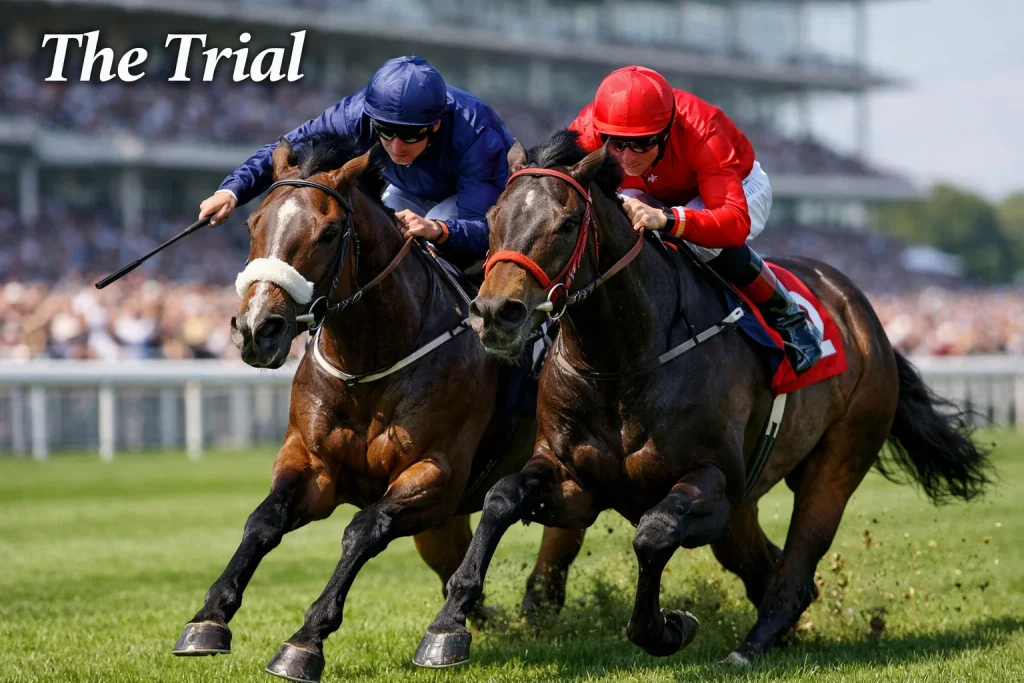
The Great Voltigeur is a Group 2 Stakes for three-year-olds, run over one mile and four furlongs at York’s Knavesmire racecourse during the Ebor Festival in August. The race was first run in 1950 and is named after Voltigeur, the 1850 St Leger and Derby winner — a horse whose name has remained synonymous with stamina and versatility for over 170 years.
The distance is key. At a mile and four furlongs, the Great Voltigeur tests staying ability without fully exposing a horse to the extreme demands of the St Leger’s mile and six furlongs. It is the same distance as the Derby and the Irish Derby, which means it attracts horses who have already proven they can handle twelve furlongs at the highest level. The question it answers — or leaves open — is whether they can handle two furlongs more.
York’s Knavesmire is a galloping, left-handed track with a straight of roughly three furlongs. It rewards horses who travel well through a race and quicken off a strong pace, which is also the profile that tends to succeed at Doncaster. The similarities in track configuration are not coincidental — both courses are flat, left-handed, and favour long-striding gallopers over nimble, sharp-turning types. A horse who is comfortable at York is structurally likely to be comfortable at Town Moor.
The timing matters too. The Great Voltigeur is run in mid-to-late August, typically four to five weeks before the St Leger. That gap aligns neatly with the optimal form recency window: long enough for a horse to recover from a hard race, short enough that the fitness gained at York carries through to Doncaster. Trainers who plan a St Leger campaign around the Great Voltigeur are working with the calendar rather than against it, and the results reflect that advantage.
15 Horses Who Won Both: The Great Voltigeur–St Leger Double
Across the full history of both races, fifteen horses have completed the Great Voltigeur–St Leger double. That number is remarkable for a trial race. No other St Leger prep has produced anything close to that conversion rate. The Gordon Stakes at Goodwood, the other commonly cited trial, has a far lower hit rate — useful for identifying staying candidates, but not the direct pipeline that the Great Voltigeur provides.
Of the last twelve St Leger winners, four ran in the Great Voltigeur beforehand. The most recent was Continuous in 2023, who won at York under Ryan Moore before travelling to Doncaster and completing the double for Aidan O’Brien. Continuous was a textbook Great Voltigeur-to-Leger winner: he won at York with something in hand, suggested he would improve for the extra distance, and delivered at Doncaster on ground that suited his style.
John Gosden, one of the most successful St Leger trainers of the modern era, has spoken about the Great Voltigeur as the ideal staging post for a Doncaster contender. In 2023, Gosden used the race to prepare Gregory, describing the York trial as the right path for a horse with St Leger ambitions. That view is widely shared among the training ranks — the Great Voltigeur is not merely a race to win but a race to learn from, and the form it produces is directly transferable to the St Leger assessment.
The double winners list includes horses from every era of the race’s existence, but the modern examples are most instructive for punters. In addition to Continuous, notable recent doubles include Logician (2019, though he ran in a lesser trial at York rather than the Great Voltigeur itself) and Kew Gardens (2018), who won at York before landing the St Leger for O’Brien. The pattern is consistent: a dominant Great Voltigeur winner who handles the distance comfortably is a prime St Leger candidate, and the market often underestimates just how strong that correlation is.
Reading the 2026 Great Voltigeur for St Leger Clues
The 2026 Great Voltigeur will be run at York in August, and this section will be updated with a full analysis once the result is known. Until then, the framework for interpreting the race remains the same year after year.
When watching the Great Voltigeur — or reviewing the result afterwards — three things matter most for St Leger purposes. First, the winning margin. A horse who wins by a comfortable margin at York has demonstrated that a mile and four furlongs is well within its range, which in turn suggests that the extra two furlongs at Doncaster will not be a problem. A horse who scrapes home by a neck, visibly tiring in the final furlong, is sending a warning signal about its stamina ceiling. The importance of these marquee trials is growing: BHA data shows that average betting turnover per race at Premier Fixtures rose by 2.7% in 2025, even as overall racing turnover declined, meaning sharper money and tighter markets converge on exactly these events.
Second, how the winner travels through the race. Data from HorseRacing.guide shows that nine of the last twelve St Leger winners had raced within 65 days of the Leger — and the Great Voltigeur fits that window perfectly. But fitness alone is not enough. A horse that is hard ridden from the two-furlong pole at York may win the Great Voltigeur but arrive at Doncaster with less in reserve than one who quickened smoothly and won on the bridle. The manner of the victory matters as much as the fact of it.
Third, the pace of the race. A slowly run Great Voltigeur that turns into a sprint over the final two furlongs does not test stamina in the way the St Leger will. A truly run race, where the pace is honest from the start and the winner sustains its effort from three furlongs out, is a far more reliable indicator of Doncaster readiness. Check the sectional times if they are available — they tell you whether the trial was genuine or whether it flattered a horse who may not stay when the pressure comes earlier at Doncaster.
Once the 2026 Great Voltigeur is complete, return to this page for a detailed breakdown of what the result means for the St Leger market. The best ante-post value often appears in the hours immediately after the York race, before the bookmakers have fully adjusted their prices.