
St Leger Trainers and Jockeys: Aidan O'Brien's Dynasty and the Record Holders
Best Horse Racing Betting Sites – Bet on Horse Racing in 2026
Loading...
In September 2025, Aidan O’Brien saddled Scandinavia to win the St Leger at Doncaster — his ninth victory in the race and his third in consecutive years. No trainer since John Scott in 1841 had managed three in a row — a gap of 184 years. The St Leger record books are full of extraordinary figures, from Victorian trainers who dominated for decades to jockeys whose names became synonymous with the race, but O’Brien’s current sequence sits in a category of its own.
What makes the Ballydoyle trainer’s record significant beyond the numbers is what it reveals about how the St Leger is won. This is not a race that rewards one-off brilliance. It rewards systems: the patient identification of stamina-bred three-year-olds, the methodical campaign through trial races, and the precise timing of peak fitness for a September appointment at Doncaster. O’Brien’s dominance is not an accident. It is the product of the most successful training operation in the history of flat racing, applied consistently to a race that most of his rivals treat as an afterthought.
This article profiles the trainers and jockeys who have shaped the St Leger, from the all-time records set in the nineteenth century to the partnerships that will define the 250th running in 2026. It covers O’Brien’s dynasty in detail, examines the Victorian figures who still hold records he has not yet broken, traces the jockey lineage from Bill Scott through Piggott and Dettori to the current generation, and explains why the Irish racing industry’s structural advantages have made Ballydoyle’s dominance possible. The numbers tell one story. The people behind them tell another.
Nine and Counting: O’Brien’s St Leger Dominance
Aidan O’Brien’s nine St Leger victories did not arrive in a sudden burst. They were accumulated over more than two decades, beginning with Milan in 2001 and continuing through a sequence that has included some of the finest stayers of the modern era. The full list reads: Milan (2001), Brian Boru (2003), Scorpion (2005), Leading Light (2013), Capri (2017), Kew Gardens (2018), Continuous (2023), Jan Brueghel (2024), and Scandinavia (2025). Each name represents a different horse, a different year, and a different set of circumstances — but all share a common thread. They were trained at Ballydoyle, campaigned through the established trial route, and delivered when it mattered most at Doncaster in September.
The three consecutive victories from 2023 to 2025 elevated O’Brien’s record from impressive to historic. Continuous won the 2023 Leger after taking the Great Voltigeur at York, confirming the trial-to-Classic pipeline that O’Brien has refined over decades. He was a son of Heart’s Cry, bred on Japanese stamina lines that had been increasingly prominent in European racing, and his victory demonstrated Ballydoyle’s willingness to look beyond traditional Irish and British bloodlines when identifying potential stayers. Jan Brueghel followed in 2024, ridden by Sean Levey, in a performance that combined tactical patience with the sustained stamina that Town Moor demands. Named after the Flemish painter — a Coolmore tradition of artistic names — he had shown his quality in the Gordon Stakes at Goodwood before stepping up to the Leger distance for the first time. And then came Scandinavia in 2025, ridden by Tom Marquand, completing the hat-trick in front of over 26,000 spectators on St Leger Day. Each horse was different in profile. What they shared was preparation.
“He has a lot of class and handles soft ground really well — we’ll discuss the Arc with Coolmore, but the Leger was always the target” — Aidan O’Brien, after Scandinavia’s victory. The quote captures something essential about O’Brien’s approach to Doncaster. The St Leger is not a fallback option when the Arc looks too competitive. It is a target in its own right, planned months in advance and executed with the full resources of the most powerful training operation in European flat racing.
To put O’Brien’s St Leger record in context, consider the broader numbers. According to Horse Racing Ireland’s Hall of Fame, O’Brien has accumulated more than 400 Group 1 victories worldwide, won ten Epsom Derbies, ten renewals of the 2000 Guineas, and more than 55 Irish Classics. He has trained multiple winners of the Breeders’ Cup, the King George, and virtually every major flat race in Europe. Against that backdrop, nine St Legers might seem like a footnote. It is not. The Leger’s unique distance, its late-season timing, and its requirement for a specific type of horse mean that sustained success in the race demands a level of depth and planning that most operations cannot sustain. O’Brien can, because Ballydoyle’s system is designed to produce exactly the kind of horse the Leger rewards: a well-bred, well-prepared stayer with the class to win a Group 1 and the stamina to last a mile and six furlongs on flat ground.
The record O’Brien is now chasing belongs to a man from a very different era. John Scott, the great Victorian trainer, won sixteen St Legers between 1827 and 1862. That record has stood for over 160 years, and while O’Brien’s rate of accumulation suggests he could challenge it if he continues training into the 2030s, the comparison itself underlines the scale of what both men have achieved. Only two trainers in 250 years have won the Leger in double figures. The gap between them and everyone else is not narrow — it is an ocean.
Before O’Brien: John Scott’s 16 and the Victorian Giants
John Scott trained at Whitewall, Malton, in North Yorkshire — roughly 60 miles from Doncaster — and for four decades he treated the St Leger as something close to a personal appointment. His sixteen victories between 1827 and 1862 represent the all-time record for any trainer in the race, a figure that has survived unchallenged for more than a century and a half. To win a Classic sixteen times is remarkable by any standard, but to do it in the nineteenth century, when training methods were rudimentary, veterinary science was primitive, and travel to the racecourse involved hours on horseback or in a carriage, required something more than talent. It required dominance.
Scott operated in an era when a handful of powerful trainers controlled the sport. The Jockey Club was the sole regulator, and the owner-trainer relationships that determined which horses ran in which races were built on personal networks rather than commercial contracts. Scott’s advantage was twofold: he had access to the best bloodstock in the north of England, and he understood the Doncaster track as well as anyone alive. His horses were prepared specifically for Town Moor’s flat, galloping surface, and his jockeys — often his own brother, Bill Scott — rode with an intimate knowledge of how the St Leger unfolded tactically.
The other Victorian trainers who left their mark on the Leger include Matthew Dawson, who won the race six times in the latter half of the nineteenth century, and John Porter, whose five victories came during a period when the race’s prestige was at its absolute peak. These were trainers for whom the St Leger was the season’s defining test, not a stepping stone to something else. The concept of bypassing Doncaster for a richer race in France would have been inconceivable to them — not least because the Arc de Triomphe did not exist until 1920.
Between the Victorian era and O’Brien’s modern dominance, no single trainer managed to build a comparable sequence. The twentieth century produced respected Leger trainers — Noel Murless (three wins), Henry Cecil (three wins), and Barry Hills — but none approached Scott’s total. The race’s training record became fragmented, with different yards winning one or two Legers before fading from contention. It was not until O’Brien’s systematic approach, underpinned by Coolmore’s resources and the depth of the Ballydoyle string, that a single training operation reasserted the kind of sustained dominance that had not been seen since the 1860s.
What connects Scott’s era to O’Brien’s is the principle of systematic targeting. Both men identified the St Leger as a race worth winning repeatedly, invested the resources to produce the right type of horse, and built a body of work that separates them from every other trainer in the race’s history. The methods are different — Ballydoyle’s satellite yards, veterinary technology, and global bloodstock network bear no resemblance to Whitewall’s Victorian stable — but the underlying logic is the same. If you want to win the Leger, you have to mean it.
Jockeys Who Defined the Leger: Scott, Piggott, Dettori
The jockey record in the St Leger mirrors the trainer record in one respect: it is dominated by a small number of riders who made the race a personal speciality. According to HorseRacingHistory.co.uk, Bill Scott leads the all-time list with nine victories, achieved between 1821 and 1846. Scott’s total is inseparable from his brother John’s training record — the two formed the most prolific family partnership in Classic racing history, with Bill riding the majority of John’s St Leger winners during a period when the race had no serious rival for the title of Britain’s most important flat contest.
Behind Bill Scott sit John Jackson and Lester Piggott, each with eight victories. Jackson’s wins came in the late eighteenth and early nineteenth centuries, making him one of the race’s earliest serial winners. Piggott’s, by contrast, are within living memory. His St Leger career spanned from 1960 to 1984 and included some of the most memorable renewals in the race’s modern history, not least Nijinsky’s Triple Crown-clinching victory in 1970. Piggott’s riding style — upright, physically powerful, tactically ruthless — was ideally suited to a race where stamina and judgement of pace mattered more than a flashy finish.
Frankie Dettori, with six St Leger victories, completes the modern elite. Dettori’s record in the race is notable for its longevity, stretching from Classic Cliche in 1995 to Logician in 2019, a span of 24 years. His victories were spread across multiple trainers and encompassed both dominant front-running performances and come-from-behind efforts that demonstrated the tactical flexibility Town Moor demands. Dettori retired from race riding in 2023, and his absence from the Leger jockey roster leaves a gap in experience that the next generation is still working to fill. In an era when jockey careers are longer and more international than ever, the depth of Dettori’s Leger knowledge — accumulated across six wins, numerous placed efforts, and decades of riding the Doncaster track in all conditions — was an asset that no current rider can claim to replicate.
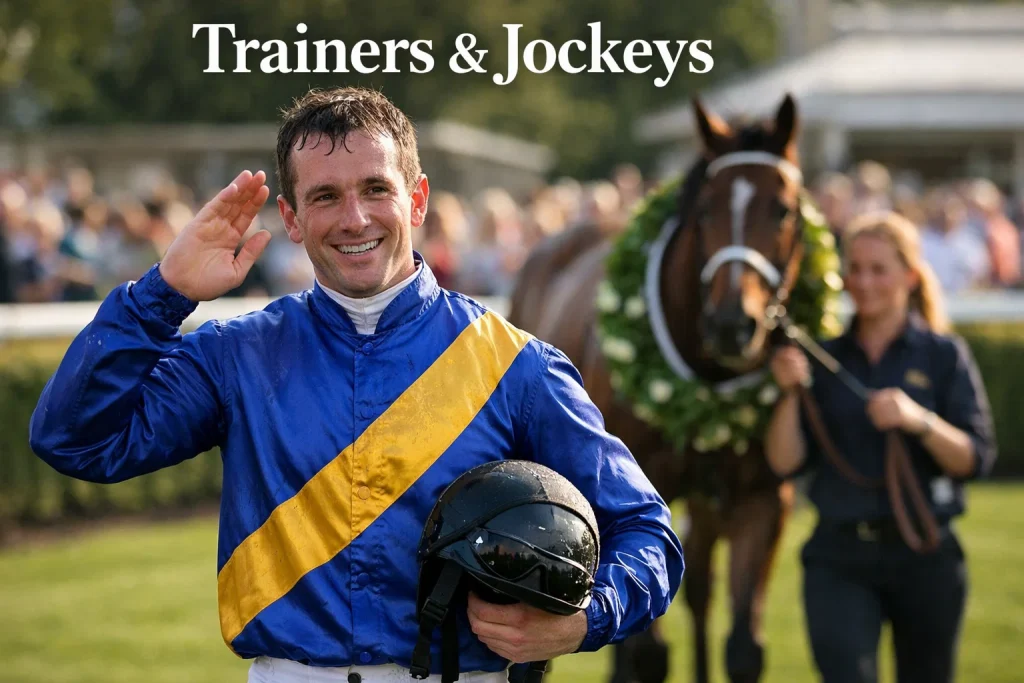
That next generation includes Tom Marquand, whose two St Leger victories — in 2020 for Joseph O’Brien and in 2025 aboard Scandinavia for Aidan O’Brien — make him the most successful active jockey in the race at the age of 27. “It’s nice to win a Leger with the stands full — last time it was Covid, and you could hear yourself think” — Tom Marquand, after Scandinavia’s 2025 victory. Marquand’s comment captures the contrast between his two wins and hints at the broader significance of the St Leger as a public spectacle, not just a sporting contest. His partnership with Aidan O’Brien, cemented by the 2025 victory, makes him the most likely jockey to add to his tally in the years ahead, particularly if Ryan Moore is committed to other Ballydoyle runners on the day.
The Ballydoyle Pipeline: Why Ireland Rules Doncaster
O’Brien’s St Leger record does not exist in isolation. It is the most visible expression of a deeper structural advantage: the Irish racing industry’s capacity to produce, train, and export top-class thoroughbreds to Britain’s biggest races. Understanding why Ballydoyle keeps winning at Doncaster requires understanding why Ireland, a country of five million people, consistently outperforms its weight in international flat racing.
The numbers make the case more persuasively than any argument. According to a Deloitte report commissioned by Horse Racing Ireland, the Irish racing and breeding industry contributed an estimated 2.46 billion euros to the national economy in 2022, a 34 per cent increase on 2016. The industry supports over 30,350 full-time-equivalent jobs and Ireland ranks second in the world for the value of public thoroughbred sales, behind only the United States. These are not the numbers of a cottage industry. They are the numbers of a national asset, funded and supported at a level that Britain’s more fragmented racing economy cannot match.
The direct impact on British racing is measurable. In 2024, Irish-trained horses earned £19.4 million in prize money in Britain — a 16 per cent increase on the previous year. That figure includes earnings from every major British meeting, from Royal Ascot to the St Leger Festival, and it reflects the consistent flow of talent from Irish yards to British racecourses. At the St Leger specifically, the recent dominance of Ballydoyle means that six of the last twelve winners have been trained in Ireland. The race has become, in practical terms, a showcase for the Irish system’s ability to produce stayers of the highest calibre.
“Prize money is critically important — we are competing with France, Japan, the USA, and Australia for owners and horses, and without adequate funding we cannot attract the investment that sustains the whole industry” — Suzanne Eade, CEO, Horse Racing Ireland. Eade’s point is not abstract. It explains why O’Brien’s Coolmore-backed operation, with its access to the best bloodlines and the most generous ownership structure in European racing, can afford to target a race like the St Leger with the kind of sustained commitment that British trainers, operating with smaller strings and tighter budgets, often cannot.
The pipeline from Ballydoyle to Doncaster is a specific route within this broader system. O’Brien typically identifies his St Leger candidates during the spring of their three-year-old season, based on pedigree analysis, gallop performance, and how they handle distance in early-season races. Those horses are then campaigned through a sequence of trials — often the Curragh’s Irish Derby in June, followed by the Great Voltigeur at York in August — before arriving at Town Moor in September with a carefully managed fitness profile. It is a process that requires depth of string (having enough horses to commit one or two to a stamina route without compromising other Classic targets), quality of information (knowing which horses will genuinely stay a mile and six furlongs), and tactical discipline (resisting the temptation to redirect a Leger candidate to the Arc at the last minute). O’Brien has all three, and that is why Ballydoyle’s September appointment with Doncaster has become the most reliable fixture in the British racing calendar.
Current Trainer-Jockey Partnerships to Watch for 2026
The most important trainer-jockey combination heading into the 2026 St Leger is, inevitably, Aidan O’Brien and Ryan Moore. Moore has been O’Brien’s first-choice rider for the major British and Irish meetings for over a decade, and his record in the Leger includes victories on Capri (2017) and Kew Gardens (2018). Moore’s style is ideally suited to Town Moor: he is a patient, cold-blooded tactician who excels at judging pace over long distances and delivering a challenge at exactly the right moment. If O’Brien has a leading St Leger candidate in 2026, Moore is the most likely rider — but the 2025 precedent, when Marquand rode Scandinavia, shows that Ballydoyle’s jockey allocation is not always predictable.
Tom Marquand’s emerging relationship with Ballydoyle makes him the most interesting jockey to follow. At 27, he has two Leger victories and an established record in the biggest races, and his willingness to travel and ride for multiple operations gives him the kind of tactical versatility that serves a jockey well at Doncaster. Whether he partners an O’Brien runner or picks up a ride from one of the British yards targeting the race, Marquand is likely to feature prominently in the 2026 renewal. The dynamics of Ballydoyle’s jockey allocation are worth monitoring closely: when O’Brien runs two horses in a Classic, the split between Moore and a second rider often reveals which the stable believes is the stronger contender, and that information is publicly available through the jockey declarations long before the bookmakers have fully adjusted their prices.
Among British trainers, the names to watch remain those with a track record of preparing stayers for the highest level. John and Thady Gosden, training from Clarehaven at Newmarket, won the Leger with Logician in 2019 and have the pedigree analysis and patient approach that the race rewards. Their operation is built on quality over quantity, and when a Gosden-trained stayer comes to Doncaster, it typically arrives with a precise fitness profile tailored to the demands of a mile and six furlongs. Ralph Beckett, whose record with middle-distance fillies and stayers has grown steadily, represents the type of British operation that could challenge Ballydoyle if the right horse emerges from the trial season. Charlie Appleby, training for Godolphin, has the resources and the quality of stock to contest any Classic, though his operation’s focus on the Derby and the Arc has historically limited Leger ambitions.
The broader picture for 2026 will not become clear until the summer trials. The Great Voltigeur at York in August and the Gordon Stakes at Goodwood in late July will reveal which trainers have committed a genuine St Leger candidate, and the jockey bookings for those trials will signal how serious each operation is about Doncaster in September. What is already clear is that any horse travelling to Town Moor will face the same question that has defined the race for 250 years: can it outrun whatever Aidan O’Brien sends across the Irish Sea? Until someone consistently answers yes, Ballydoyle’s September appointment with Doncaster remains the most significant partnership in the Leger’s modern history.
The 250th St Leger in September 2026 will be shaped by the trainers and jockeys who have defined the race’s recent era — and by those looking to break into a narrative that Ballydoyle has dominated for a quarter of a century. The trial season begins in the summer, and the entries, jockey bookings, and pre-race interviews will tell you more about each operation’s intentions than any betting market. Watch the people, then back the horse.